
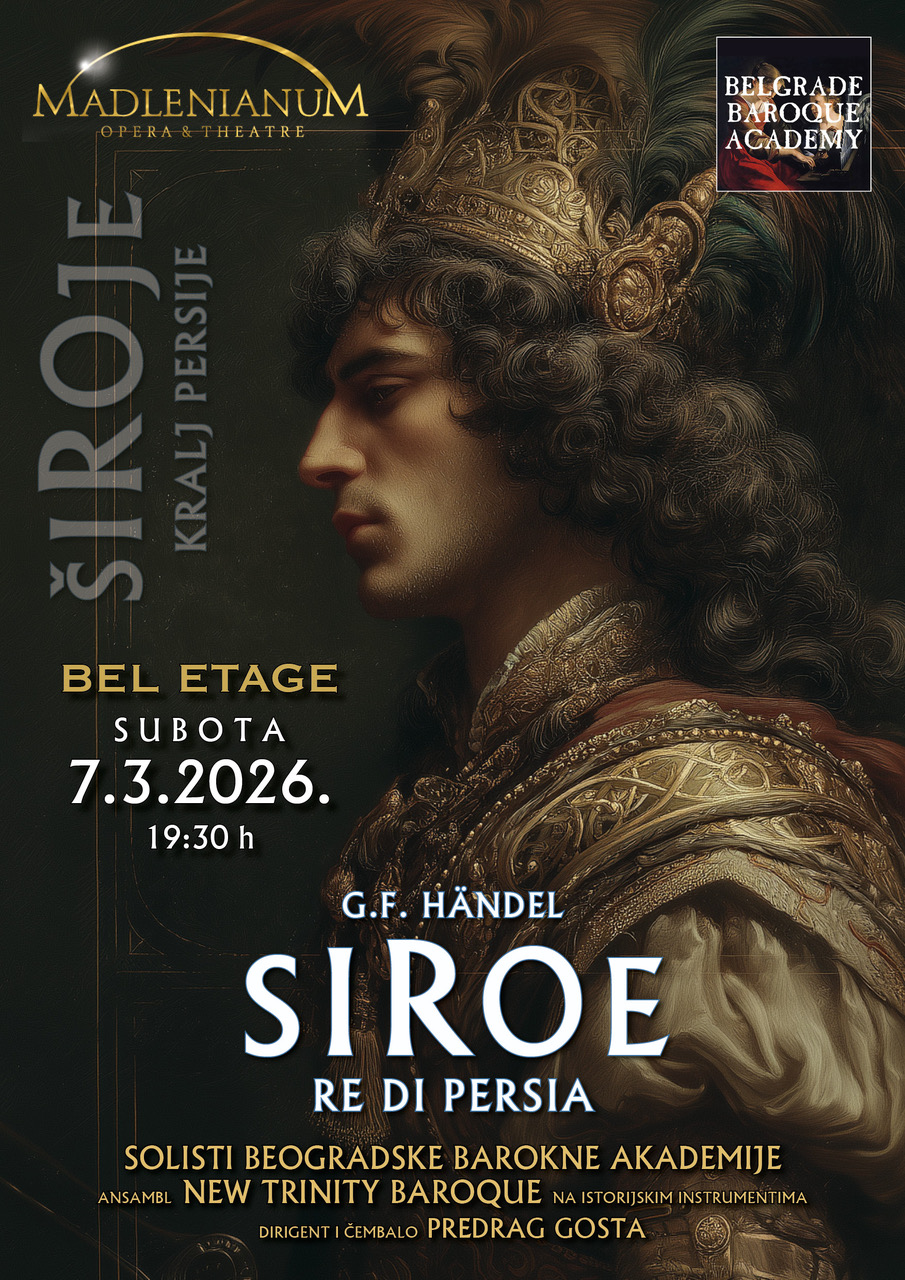
Georg Friedrich Händel
SIROE, KING OF PERSIA
Book & Buy Tickets Odštampaj
Saturday, 7th March 2026 at 19:30h
Bel Etage - Madlenianum
SIROE, KING OF PERSIA
(Siroe, re di Persia)
PREMIERE
Conductor and harpsichord: Predrag Gosta
Ensemble “New Trinity Baroque”
on period instruments
Vocal soloists of the Belgrade Baroque Academy:
- Cosroe (Khosrow II, Shah of Persia)– Sreten Manojlovic, bass-baritone
- Siroe (Siroes, the eldest son of Khosrow II, future Shah Kavadh II) – Biraj Barkakaty, countertenor (UK/USA)
- Medarse (younger son of Khosrow II) – Sandro Rossi, countertenor (Italy/Belgium)
- Emira (Princess of Cambay) – Silvija Radjen Kumar, soprano (Croatia/India)
- Laodice (Laodice, Khosrow's favourite) – Zorica Pavlovic, soprano (USA)
- Arasse (Arasse, general of the Persian army) – Predrag Gosta, baritone
Mentors of the Baroque Academy: Simone Pirri (Italy), Radoslava Vorgic, Sreten Manojlovic, Sandro Rossi and Predrag Gosta
The opera "Siroe, re di Persia" represents one of the subtlest and psychologically profound achievements in the operatic oeuvre of George Frideric Handel. The plot is set at the Persian court and follows the complex relationships between a father and his sons, the conflict between duty and love, as well as the struggle between personal honour and political power.
At the centre of the drama is Prince Siroes - the legitimate heir to the throne, unjustly accused of treason and torn between loyalty to his father and his love for Princess Emira. Through a series of moral trials and misguided decisions, the opera raises questions about justice, sovereign responsibility and human weakness. Through the relationships between father and sons, as well as the juxtaposition of love and duty, Handel creates a musical world of exceptional emotional depth, in which the inner conflicts of the characters carry as much weight as the story itself.
Handel's music in the opera "Siroe" is characterized by exceptional expressiveness and nuanced character portrayal. The arias are rich in contrasts - from deeply introspective and melancholic melodies to thrilling, fast arias full of coloratura, which depict explosions of passion and determination. The recitatives shape the dramatic tension and drive the narrative flow of the plot. A special place is occupied by the arias of Siroes and Emira, which rank among the most beautiful examples of Handel's operatic lyricism.
This performance also offers the rare opportunity to hear two countertenors on the same stage in the leading roles - a voice type that held a central place in Baroque opera and today represents one of the most distinctive expressions of historically informed performance.
Although less frequently performed compared to some of Handel's other works, "Siroe, re di Persia" is increasingly recognized today as a jewel of the Baroque operatic repertoire - a work that demands top-tier singers, stylistic precision and a deep understanding of the dramatic content. The opera was premiered in 1728 at the King's Theatre in the Haymarket, London, with the famous castrato Senesino in the title role of Prince Siroes. Emira was sung by Faustina Bordoni, Laodice by Francesca Cuzzoni, while the role of King Cosroe was performed by bass Giuseppe Maria Boschi.
This concert performance, accompanied by stylized stage movement, represents the culmination of the intensive educational and artistic work of the jubilee 25th Belgrade Baroque Academy, which over nine days of intensive musical workshops brings together young singers and instrumentalists, working with them on the stylistic, musical, and dramatic aspects of Baroque opera. The project combines a pedagogical process with research work, offering the audience a rare opportunity to hear one of the less frequently performed, yet exceptionally valuable works of the Baroque musical heritage. The opera "Siroe" is being performed for the first time in Serbia and the region.